
Paint protection film handles the rocks. But rocks are only one of the things North Texas throws at a vehicle, and for most owners the daily frustrations are different — a black interior that is unbearable by two in the afternoon, hard water spots that will not come off, a finish that looks dull three years in, or a color the factory chose that you never quite loved.
Three services address those problems, and they work well together. Here is what each one does, and how owners across Frisco, Prosper, Plano and McKinney tend to combine them.
NanoPro Ceramic Coating: Protection You Can Document
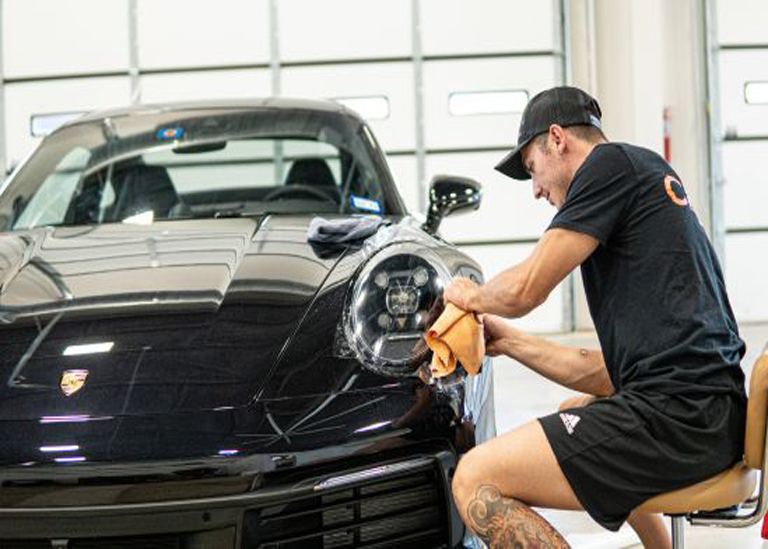
A ceramic coating is a liquid polymer, typically silica-based, applied to properly prepared paint and cured into a hard, transparent layer chemically bonded to the clear coat.
The word “bonded” matters. A wax sits on top of paint and is stripped by detergent, heat and time — a few weeks of Texas summer removes most waxes entirely. A ceramic coating cross-links with the clear coat and becomes a semi-permanent part of the surface. It does not wash off and it does not melt off in August.
What that layer gives you
Water beads tightly and sheets off rather than lying flat, which in a region with hard municipal water directly reduces mineral spotting — one of the most common paint complaints in DFW. The coating acts as a sacrificial barrier against bird droppings, bug residue, tree sap, brake dust and road tar, so those land on the coating instead of your clear coat. It substantially reduces UV transmission to the paint below, which matters where oxidation and fade are the default outcome, particularly on red and dark colors. It fills microscopic irregularities in the clear coat, so paint looks deeper and holds that look between washes. And dirt does not bond as aggressively, so washing takes less effort and less mechanical contact — which itself means less marring over time.
What a coating does not do
A coating does not stop rock chips. It is measured in microns, and a rock strike at highway speed carries far more energy than a few microns of silica can absorb. If impact protection is the goal, that is paint protection film — the single most important distinction in this industry and the one most frequently blurred. A coating also does not make paint scratch-proof and does not eliminate washing. It makes everything easier, not unnecessary.
Preparation is most of the job
A coating is transparent and semi-permanent, so whatever condition the paint is in when it goes on is the condition it stays in, sealed under a hard layer, for years. Swirl marks get locked in. Water spots get locked in.
Proper preparation means a thorough wash and chemical decontamination, iron removal, clay decontamination, and then paint correction — machine polishing to remove swirls and light defects. That correction is where the hours go and where the visible transformation comes from. Even a new vehicle usually needs some, since factory paint often arrives with transport marring and dealer wash damage already in it.
Why NanoPro, and why CARFAX matters
NanoPro Ceramic Coatings is a manufacturer rather than a rebrander, which is less common in this industry than you would think. Everything is formulated and produced in-house in the USA at their Florida facility, which means batch consistency — the coating on your car behaves the way we expect it to.
The Coat Lab offers NanoPro in 5-year and lifetime tiers, and every NanoPro coating is registered to the vehicle’s CARFAX. Every seller says their car was well maintained; almost none can prove it. A CARFAX entry showing a professionally installed ceramic coating is third-party documentation on the same report a buyer is already reading, and it supports your asking price in a way photographs do not.
LLumar IRX Ceramic Window Tint: The Number That Actually Matters
Every tint conversation eventually arrives at a percentage. Owners know exactly how dark they want the car to look, which is a reasonable place to start — but darkness and heat are not the same thing.
Where the heat actually comes from
Sunlight arrives in three bands. Ultraviolet is roughly three percent of the energy and contributes almost nothing to cabin temperature — what it does instead is destroy dashboards, dry out leather and discolor trim. Visible light is around forty-four percent, and that is what film darkness controls. Infrared is the remaining fifty-three percent, and it is responsible for most of the heat you feel.
More than half the solar heat entering your vehicle arrives in a band your eyes cannot see. A film chosen purely on how dark it looks is being chosen on the wrong variable.
What nano-ceramic technology changes
Older technologies each came with a compromise. Dyed film absorbs energy in a pigment layer, gets dark cheaply, rejects little heat, and eventually fades to purple and bubbles under Texas UV. Metalized film reflects infrared well but interferes with GPS, cellular, satellite radio, keyless entry and tire pressure sensors.
Nano-ceramic film embeds microscopic ceramic particles that interact strongly with infrared while remaining largely transparent to visible light. That decoupling is the whole point: you no longer have to choose between a car that looks the way you want and one that stays cool. Ceramic particles are non-conductive, so nothing loses signal, and ceramic does not fade the way organic dyes do.
What IRX adds
The LLumar IRx Series is the top of LLumar’s ceramic range, built around targeting infrared specifically. It blocks up to 99% of UV rays at any shade, uses concentrated infrared blocking for real cabin heat reduction, reduces glare, preserves electronic connectivity and provides discreet privacy. It comes in multiple shades and heat-rejection levels — including lighter shades that stay within Texas front-window limits while still rejecting serious heat.
If your vehicle has a large glass roof — a Porsche Cayenne, a Model 3 or Model Y, a Land Cruiser — that roof is likely the highest-value glass to treat. Horizontal glass takes near-perpendicular sun during the hottest hours, the area is large, and the factory shade is fabric, which absorbs heat and radiates it downward. The shade blocks light, not heat. On an EV there is a second benefit: climate control draws from the traction battery, so cutting cabin heat load cuts energy spent cooling.
Vinyl Wrap: Change the Car Without Touching the Paint
The third service solves a different problem entirely — you like the car, but not the color.
Why wrapping beats repainting
An aftermarket repaint reduces what your vehicle is worth. Any buyer, dealer or appraiser treats non-original paint as a flag, and meter readings that come back non-factory cost real money at trade-in.
A wrap does the opposite. The factory paint underneath stays exactly as it left the plant, shielded from UV and light abrasion, and comes off cleanly when quality material is professionally removed. For a leased vehicle it is the only viable way to change the color at all.
The practical advantages stack up: a quality paint job takes up to two weeks, a wrap about two days. A high-quality wrap costs less than a high-quality paint job. Wraps avoid the failure modes paint is prone to — fading, flaking, dry spray, runs, fish eyes, orange peel — and serve as a barrier against road debris and weathering.
The finishes paint cannot produce
Brushed metal effects, satin chrome, color-shift films and forged carbon patterns are not achievable in a spray booth at any price.
Satin has taken over the performance space for good reason. Satin black on an AMG GT63 S or a McLaren 570S diffuses reflection without eliminating it, giving panels a depth gloss cannot produce. Satin chrome on a large SUV like an AMG GLE has a metallic quality that shifts dramatically with the light. And some things only make sense in vinyl — a Bronco in bright pink is a two-year decision rather than a permanent one.
Partial work delivers the most per dollar
Full color changes get the attention, but partial wraps often deliver more. A gloss black roof creates a floating-roof effect manufacturers charge thousands for as a factory option. Chrome delete — wrapping bright window surrounds, grille slats, badges and handles in gloss or satin black — instantly modernizes a vehicle, and paired with ceramic tint it transforms a large SUV like an Infiniti QX80 completely. The reverse works too: on a Porsche Cayenne with a lot of gloss black trim, satin vinyl over selected accents adds contrast the factory finish lacks.
Material matters in this climate
A dark wrap on a horizontal panel in a Frisco parking lot in August faces temperatures that find the limits of any material. Cheap vinyl fades, cracks along body lines, lifts at the edges and leaves residue on removal — turning a cosmetic project into a paint correction bill. We use 3M, Avery and SunTek, built with UV inhibitors, air-release adhesives and the dimensional stability to handle constant thermal cycling.
How These Services Work Together
Most owners who are happy with their result used more than one.
The common specification on a high-value vehicle is paint protection film on the impact zones, a ceramic coating over the entire vehicle including the film, and ceramic tint throughout. Film handles impact, coating handles chemistry and cleaning, tint handles heat and interior preservation. Vinyl work layers on top whenever the owner wants a visual change.
Sequencing matters: correct the paint, then film, then coat. Tint is independent and can be scheduled alongside. Doing it out of order means redoing work, which is why planning the full specification as one project is usually cheaper than three separate visits.
Frequently asked questions
How long does a ceramic coating last? NanoPro is available in 5-year and lifetime tiers. Real-world performance depends on storage, wash practices and maintenance.
Is ceramic tint worth the extra cost over standard film? In North Texas the heat rejection difference is felt daily for five months a year, and ceramic does not fade or turn purple, so it does not need replacing on a cycle.
Can I coat a wrapped or matte vehicle? Yes, with a coating formulated for that finish. Never use a gloss-enhancing product on satin or matte.
Where are you located? The Coat Lab is at 11176 Winjammer Dr, Frisco, TX 75036, serving Frisco, Plano, McKinney, Prosper, Little Elm, The Colony, Celina, Allen, Lewisville, Denton, Dallas, Fort Worth and the wider metroplex.
Buy once
The theme running through all three services is the same. Cheap coatings, cheap film and cheap vinyl are not savings in this climate — they are deferrals, and the deferred cost includes years of driving a hotter, duller, harder-to-clean car.
GET A QUOTE TODAY
Call The Coat Lab at 888-966-9456